

 AI-generated
 AI-generated
 AI-generated
Foosball defence: the V position and the bank shot
Contents
You do not win in defence with quick reflexes but with the right position. The V position lets you stop more shots, and the balls you block stay with you.
Once you have the ball, you do not have to pass it forward. With the bank shot, also called the angle shot, you can score straight from your 2-bar.
V position: setting your goalkeeper and 2-bar
A good striker is almost always faster than you can react. So frantic chasing does not help you in defence. The right position does. In the V position you angle your 2-bar and your goalkeeper slightly: the feet of the 2-bar point a little towards your goalkeeper, the goalkeeper's feet a little towards your 2-bar. Seen from the side, the two figures then form a V.
Why the V position works
- Blocked balls stay with you instead of rolling back to the other side.
- Angled shots have less room, because your figures cut down the angles.
- You play with more calm, because you have to guess less.
3 steps to the V position
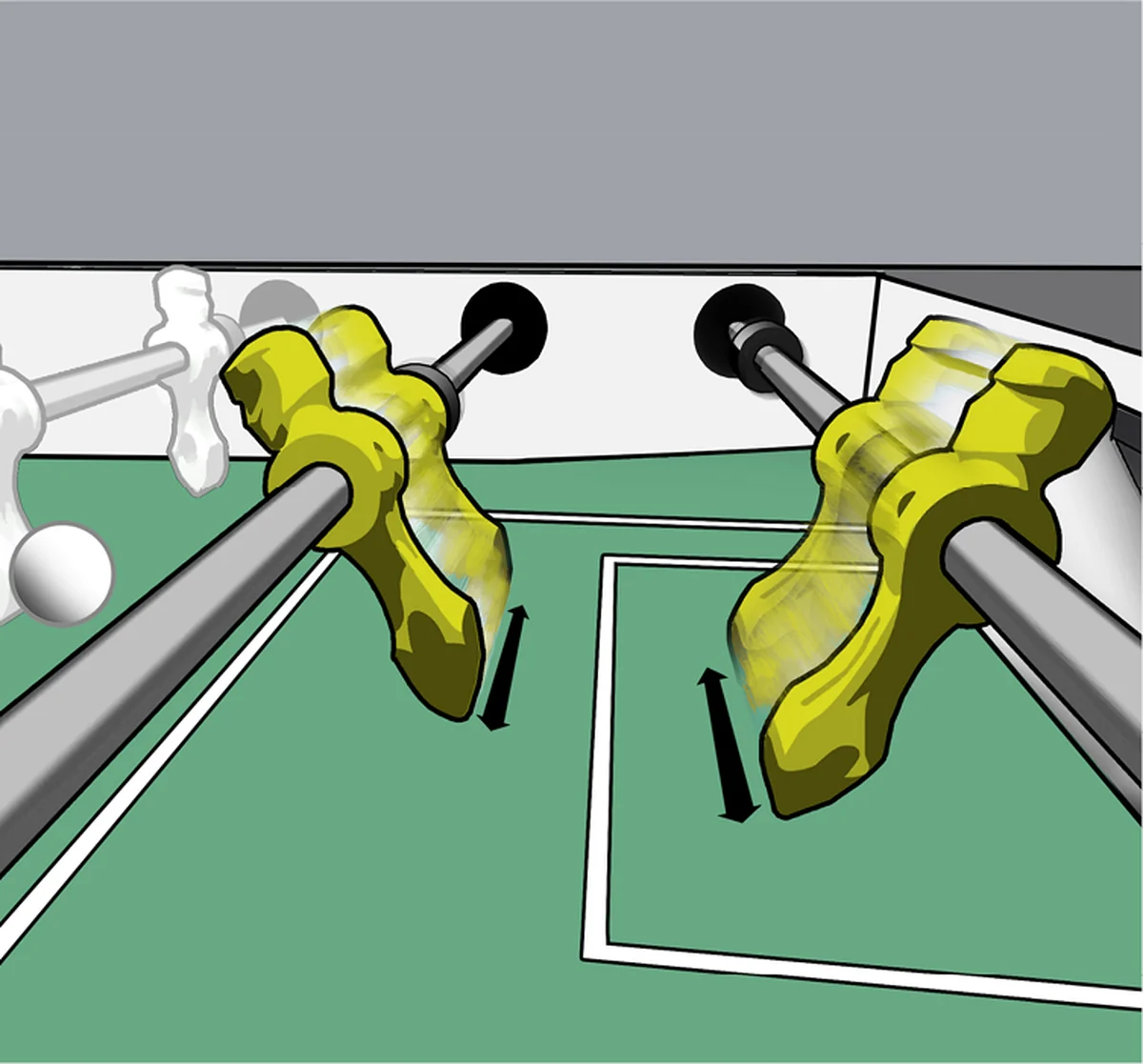
Step 1: The idea
Accept that the striker is faster than you. So do not just chase the ball. Set your goalkeeper and 2-bar offset to the side of each other. Together they cover more of the goal than two figures standing one behind the other.
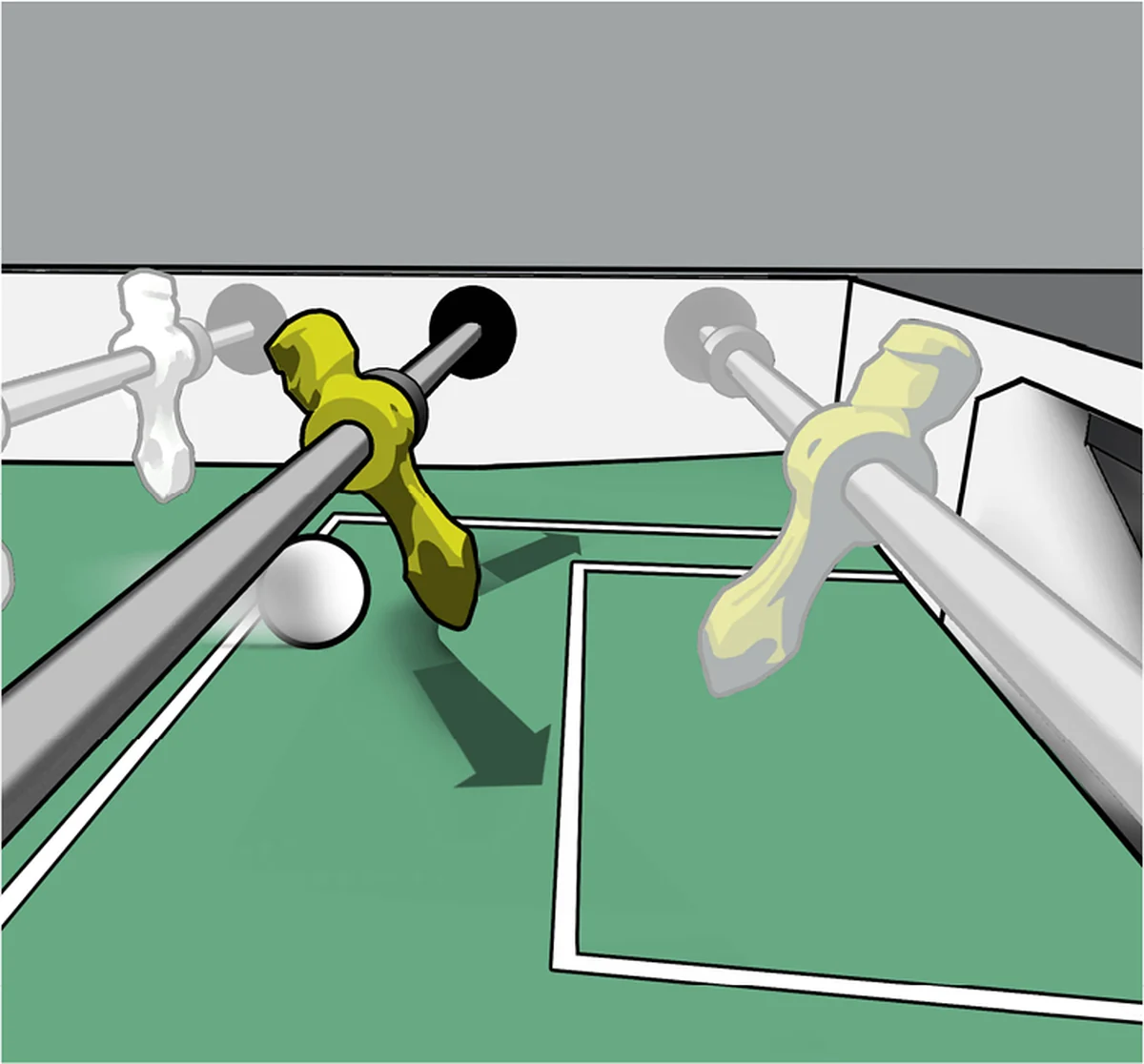
Step 2: Angle the 2-bar
Angle the figures of your 2-bar slightly so their feet point a little towards your goalkeeper. If a ball hits the figure, it rolls into your own defensive area and not back to the other side. At the same time you cut down the angle for angled shots.
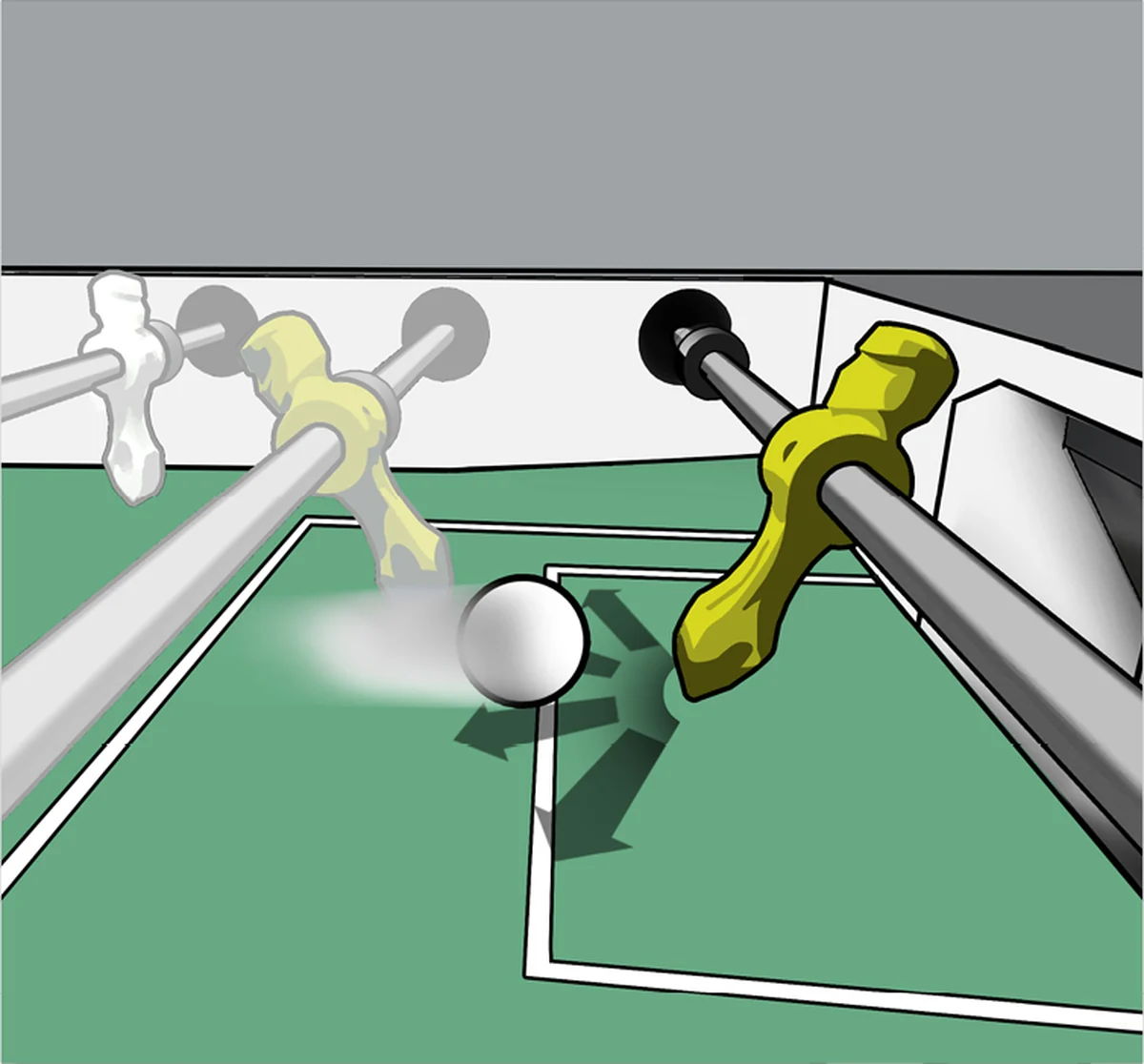
Step 3: Angle the goalkeeper
Angle your goalkeeper slightly so its feet point a little towards your 2-bar. If a ball hits it, it rolls back into your defensive area and not into your own goal. Here too you cut down the angles for angled shots.
Common V position mistakes
- Goalkeeper and 2-bar stand one behind the other. You cover one spot twice and leave another open.
- The figures hang straight down. Rebounds then bounce back to the other side.
- You angle the figures too much. Low balls roll under the figure.
- You stand still. A goalkeeper who stands still is easy to read.
Tip for advanced players: V position
Make sure your figures never stand one behind the other, but are always offset to the side. Cross your 2-bar and goalkeeper as rarely as you can. And keep moving all the time. Steady movement forces the striker to wait, and waiting costs them confidence.
Lunch-break drill: V position in 5 minutes
- 1 minute: Set up the V position and look at it from the side. Both figures offset to the side.
- 3 minutes: A colleague takes ten shots from the 3-bar. You defend with the V position only. Count how many rebounds stay with you.
- 1 minute: Swap roles. Whoever keeps more balls wins.
Bank shot: the angle shot from defence
Attack is the best form of defence. With the bank shot you play the ball from your 2-bar off the side wall straight at the other goal. The ball takes an angle that the opposing rods find hard to block. That is why some players also call it an angle shot.
Why the bank shot works
- You can score from defence. Many players do not see it coming.
- The ball runs past the opposing figures instead of through them.
- It forces the other side to watch the walls too. That opens up the middle.
3 steps to the bank shot
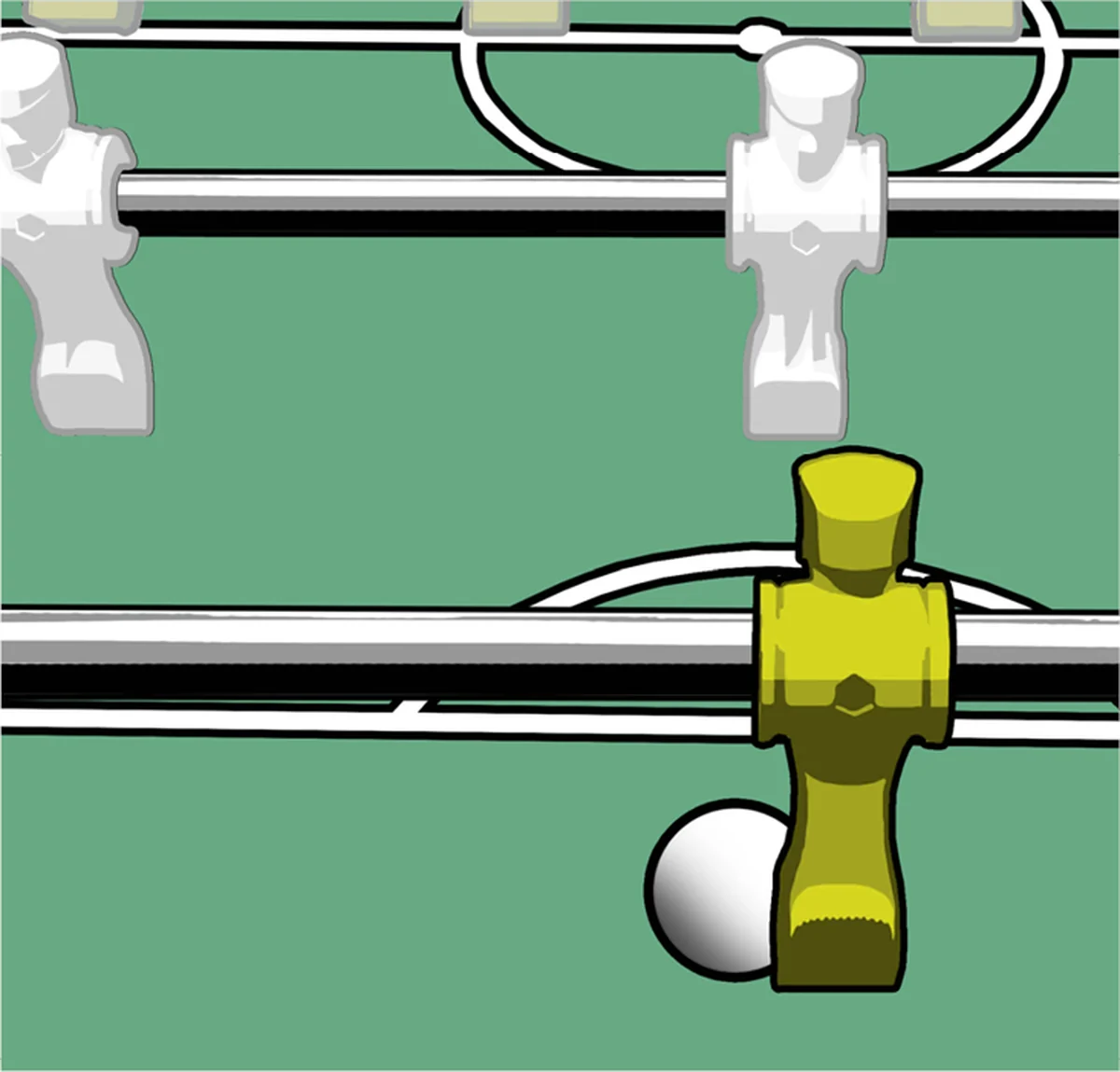
Step 1: The idea
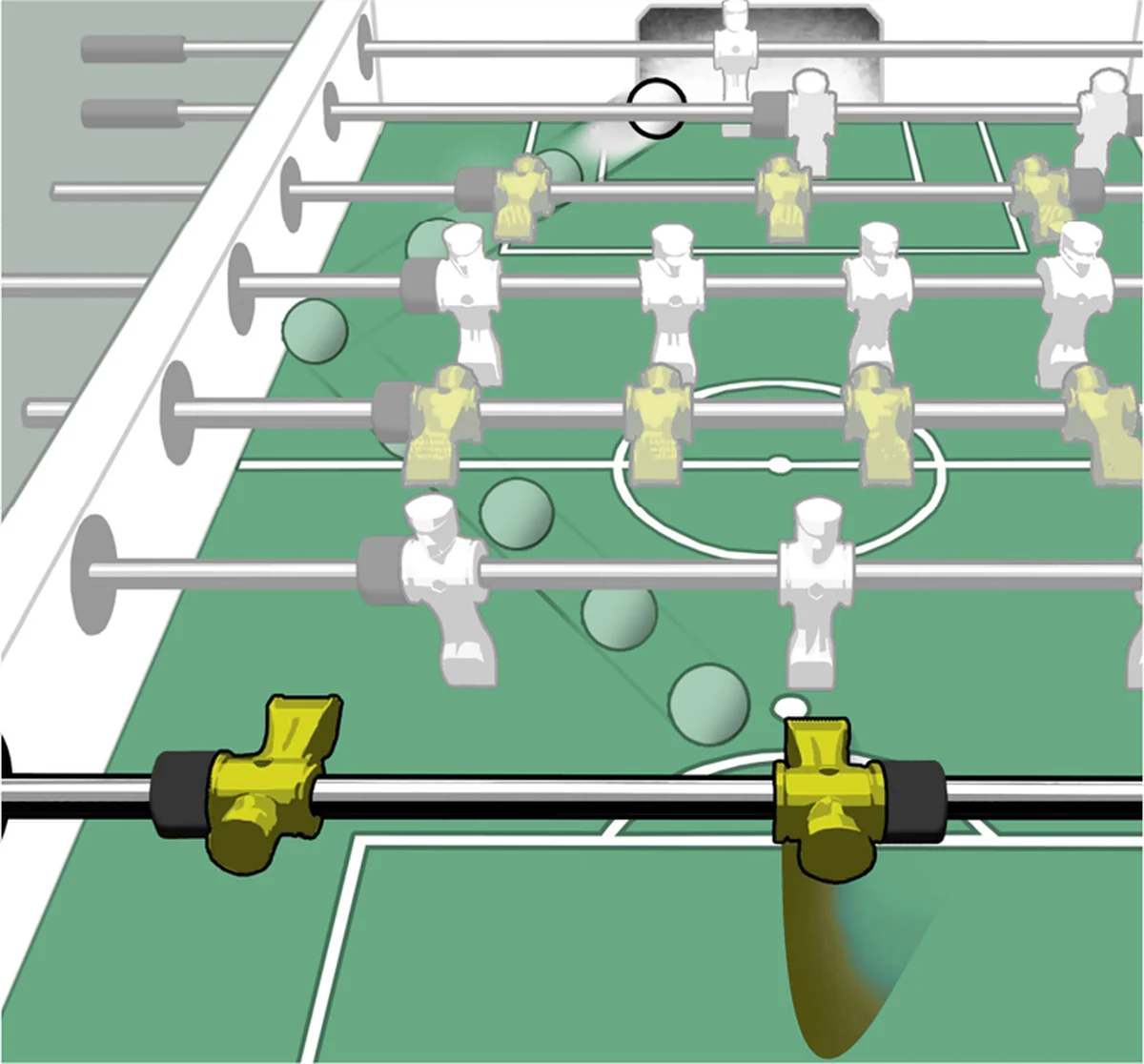
Put the ball in the middle under the rod of your 2-bar. Place the figure behind the ball, offset to one side. That sideways offset sets the angle.
Step 2: Case 1, ball in the middle
Lift the figure back. That is your wind-up. Then tip it forward with a swing. Aim for the side wall on the far side, roughly level with the other team's 5-bar. From there the ball bounces towards the goal.
Step 3: Case 2, ball at the edge of the goal area
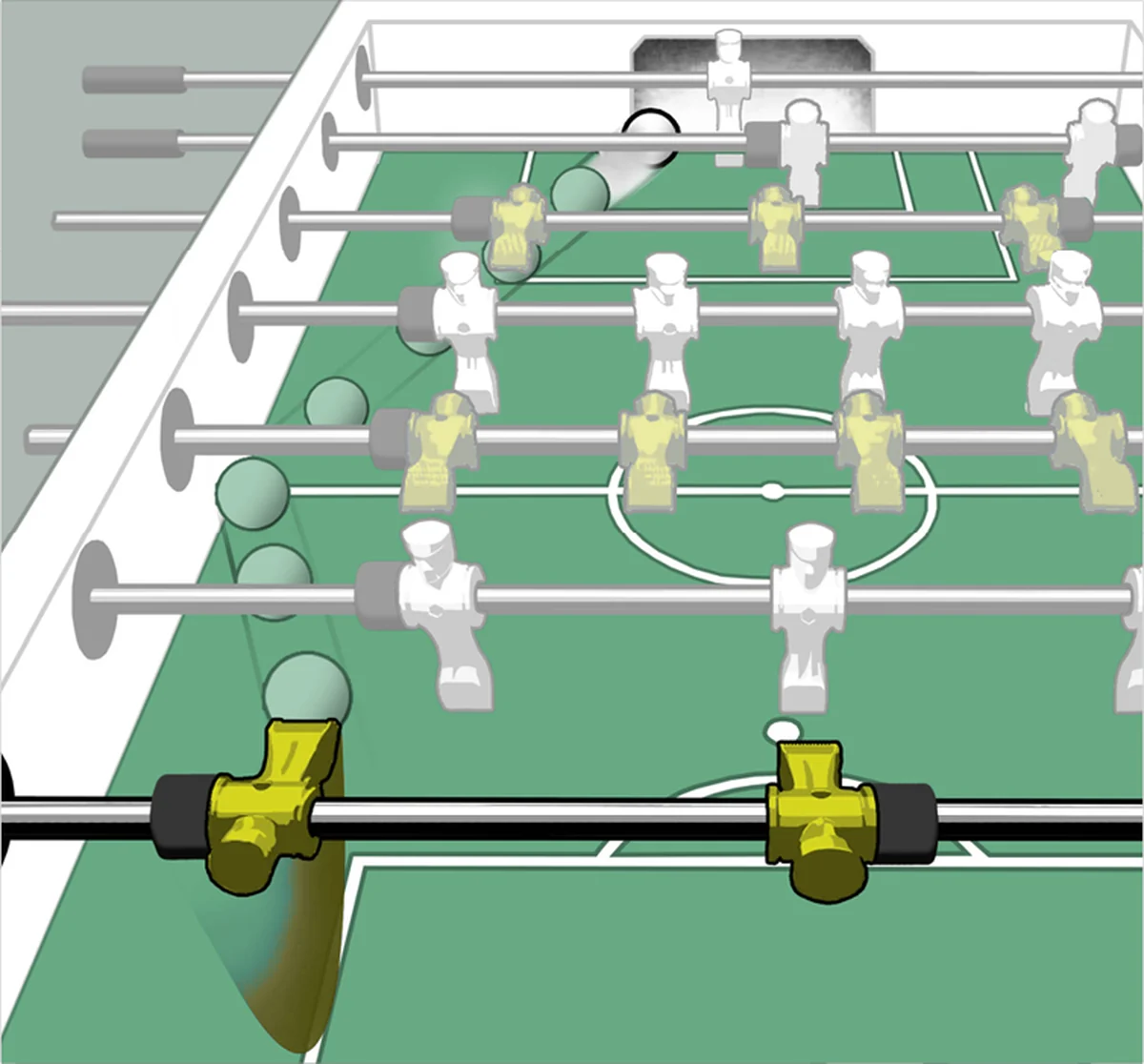
Put the ball under your 2-bar again, this time level with the edge of the goal area. Now aim for the wall roughly level with your own 5-bar. The rest is the same as case 1. The closer the ball is to the wall, the earlier it has to hit it.
Common bank shot mistakes
- You aim at the goal instead of the wall. The bank shot needs a fixed target point on the wall.
- The angle is wrong. The ball bounces wide of the goal. Start with a small offset and work your way in.
- Not enough swing. The ball loses pace off the wall and dies in midfield.
- You play it too often. It works as a surprise, not as your standard move.
Tip for advanced players: Bank shot
You can bank the ball off the wall from any position. Try to hit a rolling ball on the move so it goes straight off the wall at goal. Then the other side cannot see what is happening until the ball reaches the wall.
Lunch-break drill: Bank shot in 5 minutes
- 1 minute: No opponent. Ball in the middle, ten shots at the wall. Mark the spot where the ball bounces off best.
- 2 minutes: Case 1 and case 2 in turn, five shots each at an empty goal.
- 2 minutes: A colleague defends with all rods. Whoever scores more from five bank shots wins.
What the rules say
V position
There is no restriction on how you set your figures. But two things are banned in defence: the rod may not turn more than 360 degrees while blocking if that plays the ball (ITSF Standard Matchplay Rules, version 2.0, section 10 "Spinning"). And you may not bump the table to put the striker off (sections 15.2 "Reset" and 15.3 "Jarring").
Bank shot
There is no special restriction on the bank shot from defence. The rule of two wall touches at most only applies to the 5-bar (ITSF Standard Matchplay Rules, version 2.0, section 12 "Wall Contact"). Mind the clock: on the goalie rods (goalkeeper and 2-bar count together) you may hold the ball for no more than 15 seconds (section 6).
Challenge your colleagues
Every office league has that one player nobody gets past. Set up a free league in packeroo, log your games and find out who has the best defence on your team.