

 AI-generated
 AI-generated
 AI-generated
Learn foosball: the packeroo foosball school
Eight foosball techniques in six lessons. Each one with three illustrated steps, the typical mistakes and a drill that fits into your lunch break.
Contents
How to learn foosball
You learn foosball at the table, not by watching. Short sessions work best, one technique at a time. That is why the foosball school follows a fixed path: control the ball first, then pass, then shoot, then defend.
Every lesson has the same structure. Three steps with drawings, the most common mistakes, a tip for advanced players and a drill that takes five minutes. Where a rule matters, there is a note with its source in the rulebook of the world federation ITSF.
Start with ball control, even if you have been playing for a while. Many missed shots begin with a ball that was not sitting right.
The learning path
Stage 1The basics
Control the ball first. Without ball control, no pass and no shot will work.
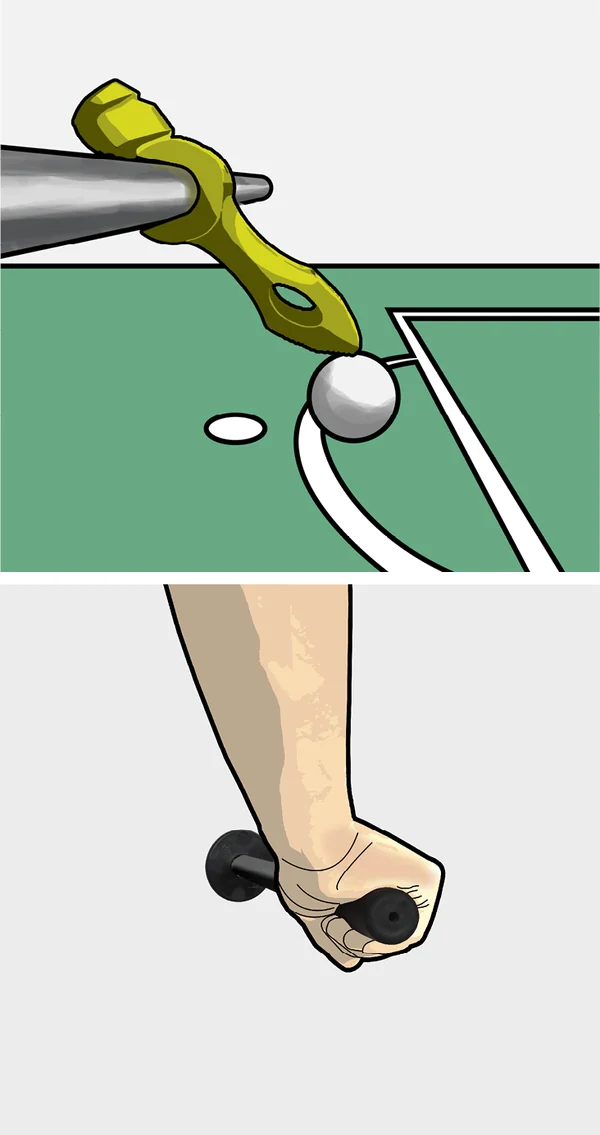
Foosball for beginners: ball control step by step
Pin the ball, tap it forwards, wipe it back. The basis for every pass and every shot.
Stage 2Passing
Then get the ball safely from midfield to your strikers.
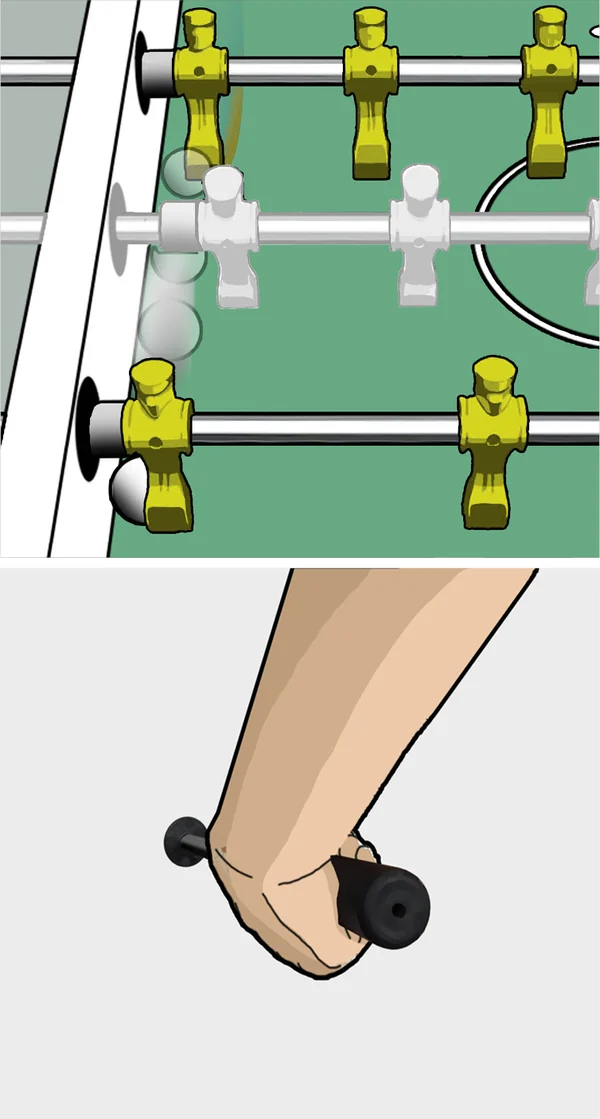
Foosball passing: the wall pass and the lane pass
From the 5-bar safely to the 3-bar: along the wall or diagonally into the field.
Stage 3Shooting
One shot at a time, from the pull shot to the snake. Learn one properly before you start the next.
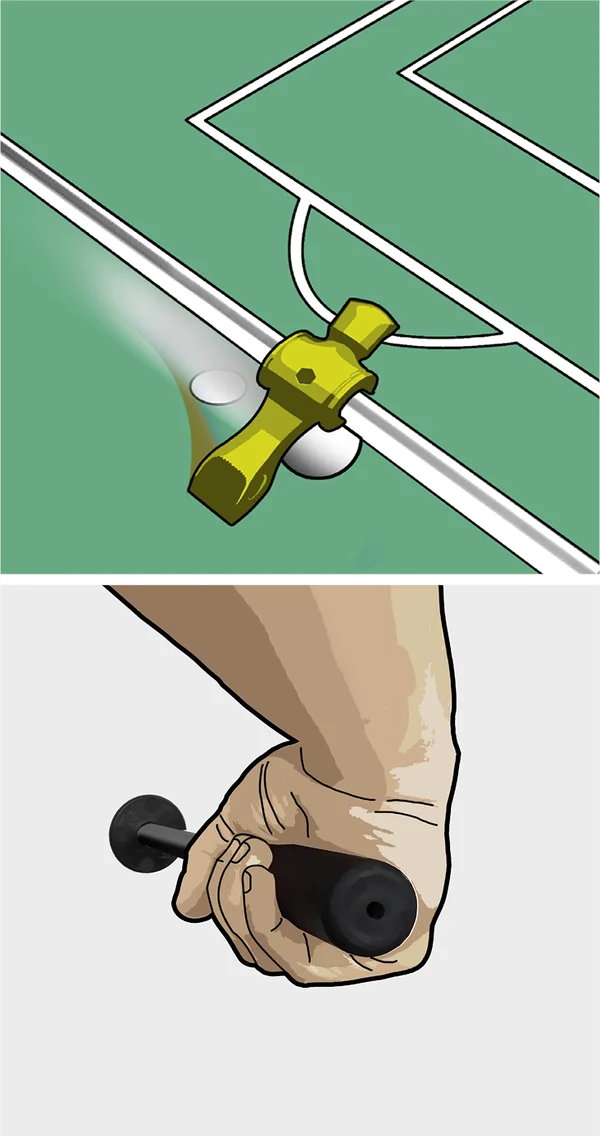
How to do the foosball pull shot, step by step
Pull the ball sideways, get ahead of it and snap in one movement. Works on almost any table.
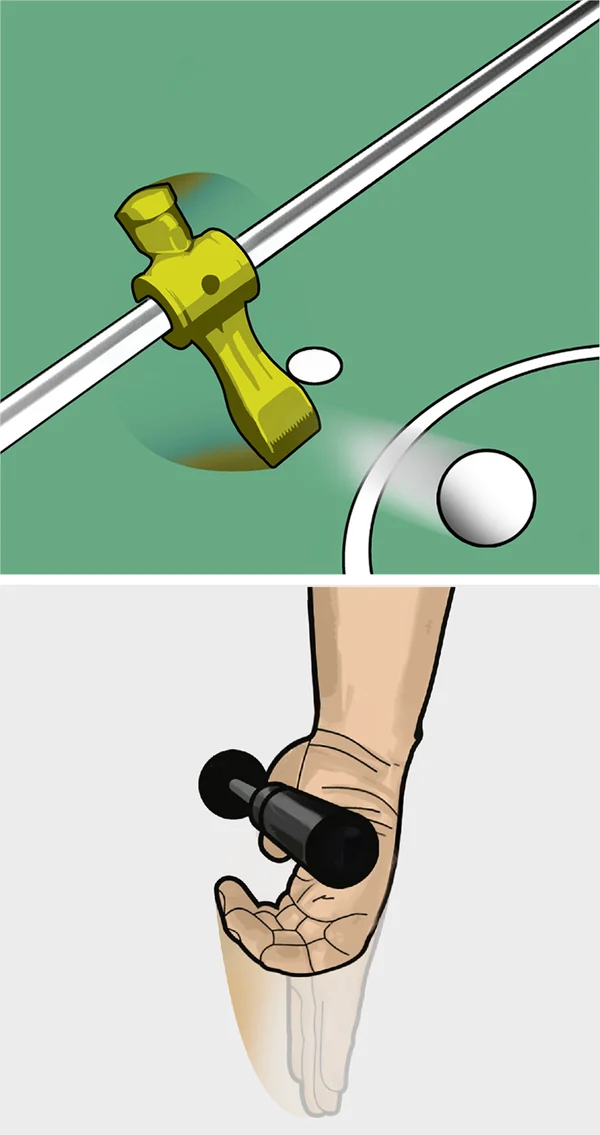
How to do the foosball pin shot, step by step
Slide over the pinned ball and let the handle roll through your open hand.
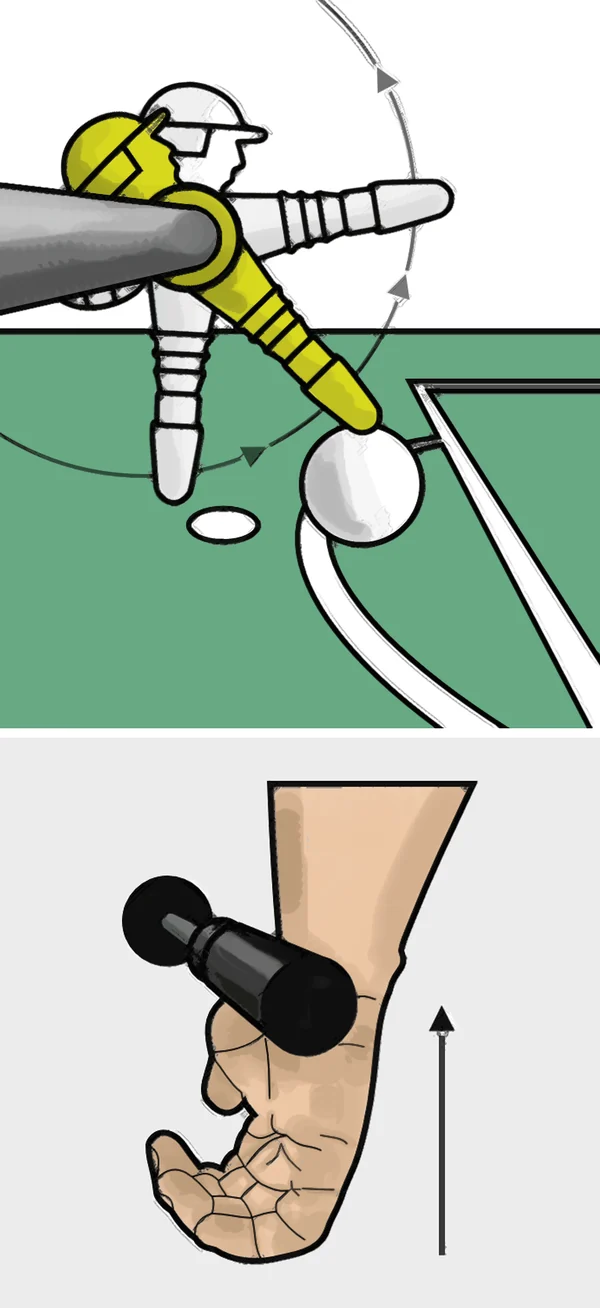
How to do the foosball snake shot, step by step
One of the best-known shots: open hand on the handle, snap up, catch the handle. Not allowed in every tournament format.
Stage 4Defence
Finally the other side of the table: stand right and become a threat from defence yourself.
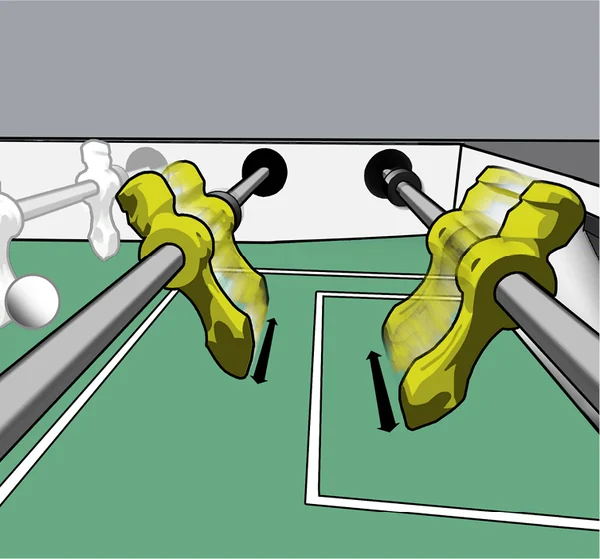
Foosball defence: the V position and the bank shot
Set your goalkeeper and 2-bar right and score off the wall from defence.
Foosball techniques in brief
- Ball control
- You pin the ball between the figure and the playing surface and move it forwards and back with small taps and wipes. That control is part of every pass and every shot.
- Wall pass
- The 5-bar draws the ball to the side wall and plays it along the wall to the 3-bar. The safest way to reach your strikers.
- Lane pass (diagonal pass)
- It starts like the wall pass. Just before the wall you clip the ball with the edge of the figure and it runs diagonally into the field. Mixed with the wall pass, it is hard to read.
- Pull shot
- The ball sits beside the figure. You pull it sideways, get ahead of it and snap your wrist down. It works on almost any table.
- Pin shot
- The ball is pinned. The figure slides sideways over it and your open hand lets the handle roll. A short movement with many variations.
- Snake shot (jet)
- The ball is pinned and the handle rests against your open hand. A quick snap upwards rolls the handle across your hand, the figure turns almost all the way round the rod and hits the ball from behind. In Germany the shot is called the jet. It is banned in the ITSF Classic format.
- V position
- Goalkeeper and 2-bar stand offset to the side and slightly angled: the 2-bar's feet point towards the goalkeeper, the goalkeeper's feet towards the 2-bar. Rebounds stay with you and angled shots have less room.
- Bank shot (angle shot)
- From the 2-bar off the side wall at the other goal. The ball runs past the opposing figures instead of through them.
Lunch-break practice plan
Five minutes a day is enough if you stick with it. This plan takes you through the learning path once in a week. Repeat the week until you hit the goals. Then add the pin shot, the snake shot and the bank shot.
| Day | Lesson | Drill (5 minutes) | Goal |
|---|---|---|---|
| Monday | Ball control | Tap and wipe, then pass the ball back and forth between two figures | Ten passes without a mistake |
| Tuesday | Passing | Ten wall passes with nobody opposite, then alternate with the lane pass | Seven out of ten passes arrive |
| Wednesday | Pull shot | Ten pull shots, alternating short and long pulls | Half of them go into the empty goal |
| Thursday | Snake shot | One minute without a ball, then ten snakes at an empty goal | You catch the handle after every shot |
| Friday | Defence | V position against ten shots from the 3-bar, then swap roles | Most rebounds stay with you |
If you practise in pairs, play a game to 5 goals on Friday and log it in your league. After a few weeks you will see what the practice has done.
Rules you should know
- Spinning: If the rod turns more than 360 degrees before or after touching the ball, it is a foul. The other side gets the ball at their 5-bar (Standard Matchplay Rules, section 10). That is why you catch the handle on the snake shot and the pin shot.
- Snake shot: Allowed under the ITSF standard rules, as long as you do not spin. In the Classic format snake shots and flip-over shots are explicitly banned (Classic Matchplay Rules, introduction). At the office, agree on it before your first game.
- Passing from the 5-bar: A ball that has been stopped or pinned may not be passed straight forward. It has to be moving again first (section 11). On the 5-bar the ball may touch the same wall no more than twice (section 12).
- Time: No more than 10 seconds on the 5-bar, 15 seconds on the 3-bar and 15 seconds on the goalkeeper and 2-bar together (section 6).
Sources: ITSF Standard Matchplay Rules, Version 2.0 (PDF), ITSF Classic Matchplay Rules, Version 1.0 (PDF)
What goes at the pub and what goes at a tournament is compared in our foosball rules.
Frequently asked questions
What is the fastest way to learn foosball?
Short, regular sessions and one technique at a time. Start with ball control, then passing, one shot and defence. Five minutes on several days does more than one long session a week.
Which foosball shot should a beginner learn first?
The pull shot. It works on almost any table and is easy to practise. After that comes the pin shot. The snake shot is the hardest and comes last.
Are the jet shot and the snake shot the same?
Yes. Jet is the German name for the snake shot, the shot where the ball is pinned and the figure turns almost all the way round the rod. In the US and in the ITSF rules it is called the snake.
Is the snake shot legal?
Under the ITSF standard rules, yes, as long as the rod does not turn more than 360 degrees before or after touching the ball. In the ITSF Classic format snake shots and flip-over shots are banned. At the office you decide for yourselves what counts.
What is spinning in foosball?
Spinning means turning the rod all the way round more than once to hit the ball. Under the official rules it is a foul, and at the pub it is frowned upon too.
Can I practise foosball on my own?
Partly. Ball control, passes with nobody opposite and shots at an empty goal all work alone. For defence and for passing under pressure you need someone on the other side.
Challenge your colleagues
Practice is more fun when it counts. Set up a free league for your office in packeroo, share the invite link in your team chat and log your games. The leaderboard shows who is ahead. Your stats show who you beat and who you still struggle against.